

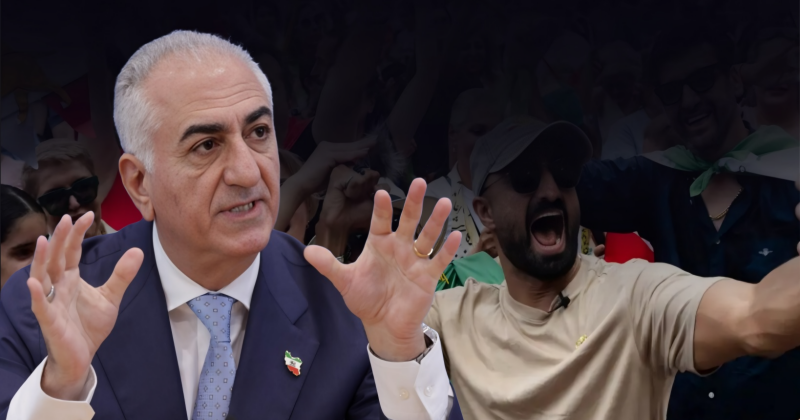
A report by [The Medes].
In recent years, and especially after the popular uprisings in Iran
the issue of "opposition unity" has always been one of the most key demands of society. However, examining the performance of Reza Pahlavi and the movement known as "Pahlaviism" indicates a deep gap between democratic slogans and the behavioral realities of this movement.
Either with me, or against me
One of the serious criticisms made of Reza Pahlavi by analysts and political activists is his real lack of desire for equal coalitions. Evidence shows that in most of his messages and speeches, instead of trying to build a united front, he emphasizes a kind of individual leadership.
He has repeatedly spoken as if the only legitimate path to struggle passes through his channel. This approach effectively places any group or movement that is defined outside the umbrella of his leadership in the ranks of "enemies" or "divisive."
The short-term experience of the "Mahsa Charter" showed how the desire to seek superiority and the refusal to accept equal weight for other groups can lead to a deadlock in collective potential.
Confrontation with other opponents
What has been observed in the field and during demonstrations abroad is far from the claim of "pluralism." Supporters of this movement have repeatedly shown violent behavior against other anti-regime groups.
Any movement that has an angle with the return of the monarchy or absolute leadership is attacked in rallies. These physical and verbal attacks cover a wide range:
Leftists and Republicans: An eliminationist approach relying on the eliminationist literature of the past.
Kurdish and ethnic parties: Accusing civil and political activists of “separatism” to justify their repression.
Other opposition groups: Attacking supporters of other organizations ( People's Mojahedin Organization of Iran ), which shows an intolerance for even the slightest different voice.
Disappointment with political maturity
Exclusive behavior and physical clashes at rallies abroad have had a devastating impact on the international community’s perception. Currently, many European analysts and governments have come to the worrying belief that the Iranian people and political movements are not yet sufficiently prepared for democracy.
Negative diplomatic perception:
When Western governments observe that the currents claiming to be an alternative cannot tolerate each other, even in the free space of Europe, and instead of dialogue, they resort to beating and boycotting each other, they conclude that the necessary infrastructure for a “sustainable democracy” is not available.
<span;>Fear of a power vacuum: This chaos and aggressive behavior have painted a picture of a possible “civil war” or the replacement of one tyranny with another in the minds of foreign observers. This has caused many Western countries to retreat from firm support for fundamental changes and to view developments in Iran with greater caution.
Creating an atmosphere of intimidation and trying to physically or morally eliminate other fighters has only served to preserve the status quo. When a part of the opposition spends its energy attacking the "non-Pahlavi opposition" instead of focusing on the common enemy, it effectively sends no message to society and the world other than a return to individual tyranny.