

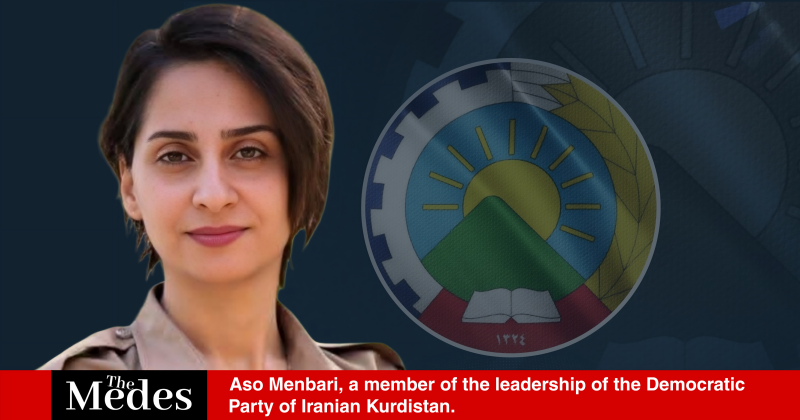
Exclusive interview by The Medes with Aso Menbari, a member of the leadership of the Democratic Party of Iranian Kurdistan.
Interview
Exclusive interview by The Medes with Aso Menbari, a member of the leadership of the Democratic Party of Iranian Kurdistan.
As the Islamic Republic is pushed to the brink of collapse by devastating military strikes from the U.S. and Israel, the Kurdish movement is preparing for a decisive transition. In this exclusive interview with The Medes, Ms. Aso Menbari, a member of the PDKI leadership, discusses the party's strategic readiness to fill the emerging power vacuum and its mission to defend Kurdistan amidst the unfolding regional war.
Medes:
Given the escalation of military tensions at the borders and recent attacks on party headquarters (such as the March 2026 strike on Camp Azadi), how does the PDKI define the line between "legitimate defense" and "entering a full-scale war"? Are there any plans to reactivate an armed presence deep within the territories of Iranian Kurdistan?
Menbari:
When a regime brazenly bombs the headquarters of a party that is home to innocent women and children, one must actually look for the limits of humanity! What happened in the past few days is an interesting matter. The US and Israel have launched their military attacks on Iranian soil, and Iran has targeted the neighboring country's soil, specifically the headquarters of Kurdish parties. At the same time, insecurity in the Kurdistan Region of Iraq has also intensified and has become a major threat to the safety and health of innocent people. This targeting demonstrates the fact that the Islamic Republic has never respected international law and whenever it faces a threat related to the weakening of its regime, it considers the Kurdish parties to be the main culprit. In fact, with this approach of the Islamic Republic, there is no longer a boundary between legitimate defense and full-scale war, and it can be said that the behavior of the Islamic Republic is not an official declaration of war against the world powers, but a war against the freedom fighters who have been trying to solve the Kurdistan issue through peaceful means for many years. In this connection, two Kurdish leaders, Dr. Abdul Rahman Ghassemluo and Dr. Sadegh Sharafkandi was martyred by the regime's terrorist diplomats while they were negotiating with the Iranian regime. Therefore, as the Democratic Party, which has had an 80-year history of fighting against the occupying regimes in Kurdistan, we always believed that our weapons were only for legitimate defense, and in such cases, we will use as much as we can to fight against the Islamic Republic in order to save the lives of innocent women and children, and we have programs for this issue.
Medes:
The formation of the "Coalition of Kurdistan Political Parties" in February 2026 received significant attention. How does this coalition differ from previous experiences (like the Cooperation Center), and as a primary pillar of this alliance, how does the PDKI intend to manage the ideological gaps between different factions, ranging from federalists to independence seekers?
Menbari:
In the past years, the Kurdistan Democratic Party of Iran was always trying to bring them together under a common umbrella by creating coordination among the parties of Kurdistan in order to have more coordination as the parties of Kurdistan in effective steps for the future of Kurdistan. In fact, the Center for the Cooperation of Iranian Kurdistan Parties was one of the centers that was able to create unity among different sections of the society in Iranian Kurdistan, and it was with the coordination of this center that the parties were able to organize the largest strikes in the history of Iran in Kurdistan as a sign of protest against the totalitarianism of the Islamic Republic. The coalition that has been formed now, which includes 6 parties of Iranian Kurdistan, was created at a different historical time. After the October 7 attacks and the unrest in the region, the equations were taken into consideration in a different way, and the unity between Kurdistan parties was one of these issues. Political activists and fighters in Iranian Kurdistan have done their best to confront the Islamic Republic over the past years, and now, by creating this coalition, they are trying to play an effective role in the future of Kurdistan. In fact, the Kurdish society is a society consisting of different parties, and the issue of pluralism is a resolved issue in the Kurdish society. At this stage of the struggle, the effort was to unite on the overall issue, that is, the future of Iranian Kurdistan! The Democratic Party of Iranian Kurdistan believes in differences, and the basis of this unity is to accept differences in line with the overall goal, at least at this historical moment. What will happen later, which I hope we will witness in the near future, is the specific program of each party on how it can demonstrate itself in the field of struggle in a democratic society. In the next stages of the struggle, the most important issue is the establishment of democracy so that the next stages can be managed under its shadow.
Medes:
With increasing speculation regarding structural changes at the top levels of the Islamic Republic's leadership, what is the PDKI's operational plan for the "day after collapse"? How will the party prevent a repetition of the 1979 experience, where Kurds were once again marginalized from the national power structure?
Menbari:
The Kurdistan Democratic Party of Iran has a specific plan for the future of Iran's governance, which is to create a federal government within which the rights of other nationalities, especially the Kurdish people, are protected. In the 1979 revolution, in the absence of a strong opposition, the achievements of a popular revolution were plundered by the Iranian regime, but over the past 47 years, the opposition's activities, especially in Kurdistan, have been remarkable and are considered an important part of Iran's future. All our efforts in the past years have been to explain that Iran is a land of diverse nationalities, ethnicities, religions, and beliefs, all of which must share in Iran's future. Our efforts have been to clearly explain our legitimate plans and demands in order to prevent any misunderstandings. Given our political struggles over the past years, the Kurdish people will be an important and undeniable part of Iran's future political equations.
Medes:
Recently, we have witnessed verbal tensions between the Kurdish coalition and certain figures of the national opposition regarding accusations of "separatism." How does the PDKI aim to balance the "right to self-determination" with engagement with centrist forces? Is a coalition still possible with groups that do not officially recognize the rights of distinct nationalities within Iran?
Menbari:
What the Democratic Party wants is clearly stated in the party's program. There is no mention of separation from Iran in any part of the party's program or statute. The Democratic Party specifically wants the rights of the Kurdish people to be realized within the framework of a democratic Iran. In essence, raising the accusation of separatism is a reaction from some individuals or groups who are fundamentally opposed to the Kurdish people achieving their human and political rights, and when there is no such demand from the Kurdish people, then no effort is necessary to prove this. We believe that through dialogue regarding our political rights, we can take the initiative, and in this regard, we have been in contact and communication with other opposition groups outside Iran for many years.
Medes:
Recent coalition statements have alluded to the "management of liberated areas" in Kurdistan. Have the PDKI and its allies prepared a specific governance model (such as cantons or local parliaments) for administering Kurdish cities in the event of a government withdrawal?
Menbari:
The coalition formed believes that everyone should have a role in managing Kurdistan, and at the current stage, the emphasis is on political coordination for the transition phase from the Islamic Republic.
Medes:
You have recently called on armed forces stationed in Kurdistan to defect from the regime. What legal or security guarantees does the PDKI offer to those military personnel who join the people's side at a critical moment?
Menbari:
The Kurdistan Democratic Party of Iran has also made similar requests to the armed forces to join the popular front in the past years. At this stage of the struggle, when the Iranian regime is at the peak of its structural weakness and there is a possibility of its collapse at any moment, this request is appropriate and necessary. The issue of security guarantees is not at issue at this stage because Iranian society is currently witnessing no internal or external security. Now, and given the events, the armed forces are forced to make a choice between the lost regime of the Supreme Leader and the liberation front, and what better way to accompany the people and the future of their country at this important and vital stage.
Medes:
Considering the Islamic Republic's pressure on the Kurdistan Region of Iraq (KRI) to restrict Eastern Kurdish parties, how does the PDKI balance the security of the KRI with the continuity of its own political-military struggle? Have you received any positive signals for official support during your recent meetings with European and American officials?
Menbari:
After the death of Jina Amini in 2022, the pressures of the Islamic Republic on the parties of Iranian Kurdistan also increased. This was while the protests over the death of Jina Amini were entirely domestic in origin, and the beginning of these protests was directly related to systematic repression, double political, economic, social pressures, etc. In all the years it has been based in the Iraqi Kurdistan Region, the Democratic Party has never used the territory of this region to act against the Islamic Republic and has made every effort to create peace in this part of Kurdistan. Now, the threats that are seen from the Islamic Republic in relation to the Kurdistan Region are the regime's reaction to the defeat imposed on it by the United States and Israel, and on the other hand, it is pursuing its own political goals by creating insecurity in the region, and especially the Kurdistan Region.
Medes:
The "Jin, Jiyan, Azadi" movement breathed new life into the struggle. How have PDKI cadres adapted the party's traditional structure to the radical and modern demands of the new generation and progressive women to ensure they do not lose the leadership of this immense potential?
Menbari:
The structure of the Kurdistan Democratic Party of Iran is not a traditional one. On the contrary, in the past years, although this party has been geographically distant from the people of Kurdistan, it has been constantly trying to minimize this gap by updating its cadres and Peshmerga. Many of those who joined this party in the last 10 years and after the announcement of the "Rasan" project were from the academic community of Kurdistan and, aware of the current needs and demands of the society, were able to have a significant impact on the Democratic Party's view of the Kurdish society, especially the new generation and women. The Democratic Party has had close ties with these groups through the women's, youth and student unions, and this relationship has had a profound impact on the party's policy-making and vision. The Democratic Party considers the zhin, Zhian, Azadi movement to be a turning point in the struggles of the Iranian people, especially the people of Kurdistan, and has tried to use this historical moment as an important political experience. The presence of these segments of society in the field was an important signal for the Democratic Party to be able to use their abilities in the future and in the progressive changes.
Medes:
The PDKI has long advocated for a "Federal and Democratic Iran." However, there is ongoing debate about whether this federation should be based on "ethnic/national geography" or "administrative/provincial" lines. Could you clarify the PDKI's specific model for federalism? How do you respond to critics who claim that an ethnic-based federalism is merely a stepping stone toward full secession?
Menbari:
The structure that the Democratic Party has emphasized for the future Iran in recent years is a geographical/national federal government. The Democratic Party believes that in a future democratic and secular Iran, different nationalities can achieve their rights without fear of being excluded and ignored. In this case, the closest field experience is the Iraqi Kurdistan Regional Government, where the Kurdish people continue their political life peacefully and within the framework of such a structure. In Iranian Kurdistan, the demand for such a structure does not mean separation but rather recognition of cultural, social, political, etc. differences. In this case, the people of Kurdistan, confident of a self-governing government and according to the laws, insist on their demands within the framework of a democratic and federal Iran.
"We are grateful to Ms. Aso Menbari for joining The Medes to discuss the PDKI’s vision and the future of Kurdistan in these decisive times."
Interview conducted by The Medes Editorial Board.
About Aso Menbari:
Aso Menbari is a member of the Leadership of the Kurdistan Democratic Party of Iran (PDKI)
Follow Aso Menbari on X : Click Here