

Despite the passage of centuries, the sun continues to stand as a symbol of life, hope, and light in the cultural heritage of this region.
KURDISTAN
()The sun symbol is one of the oldest and most enduring symbols in the history of human cultures. In many ancient civilizations, the sun was not only a natural phenomenon but also a symbol of power, life, and the order of the universe. In the land of Kurdistan, numerous archaeological discoveries show that this symbol has been present in the art and architecture of the region’s inhabitants for thousands of years.
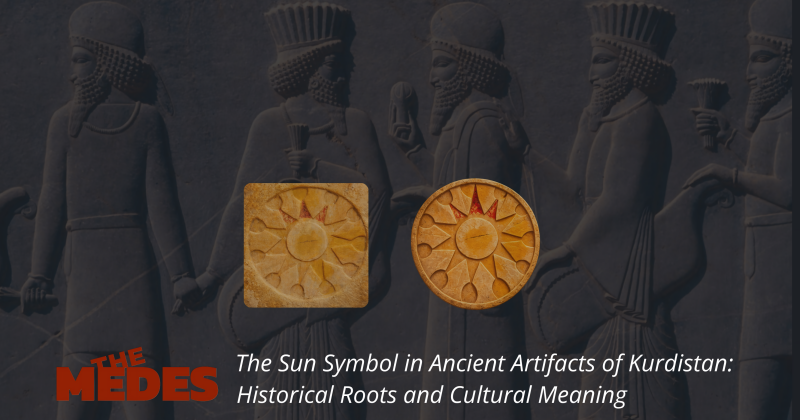
One notable example of these artifacts is a sun engraving carved into stone, typically depicted as a circle at the center with rays extending outward. These types of designs are often found in stone carvings, the walls of ancient structures, or stone fragments that once formed part of historical buildings. They reflect the significance of the sun in the beliefs and daily lives of ancient communities.
In ancient times, the sun was the most important source of light and warmth for human life. Agricultural societies depended heavily on the movement of the sun and the changing seasons, as the timing of planting, harvesting, and many daily activities was closely linked to the natural cycle of the sun.
For this reason, the sun became a symbol of life, fertility, strength, and the continuity of nature in many ancient cultures. People believed that the sun possessed the power to drive away darkness and bring light and vitality to the world. These beliefs led to the sun’s image becoming a prominent element in art, rituals, and architecture.
In many ancient areas of Kurdistan, stones bearing sun carvings have been discovered, indicating that this symbol held an important place in the cultures that once inhabited the region.
Historical Roots and Connection to the Medes
Research on ancient stone carvings in Kurdistan shows that the sun symbol with organized rays is linked to the period of the Medes, which emerged around the 7th century BCE. This era represents one of the most important historical periods in the region’s early political and cultural development.
During this time, the communities living in the region developed distinctive artistic traditions and symbolic expressions. The sun symbol with symmetrical rays appears in several ancient artistic forms associated with this historical era and reflects concepts of power, cosmic order, and the life-giving forces of nature.
The presence of this symbol in ancient stone carvings demonstrates the cultural and symbolic importance of the sun within the traditions connected to the Medes.
Structure and Form of the Sun Symbol
In many discovered artifacts, the sun is represented as a central circle surrounded by a series of rays. These rays sometimes appear as triangular shapes, geometric forms, or simple lines.
In some examples, the number of rays is twelve. Researchers interpret this number as a representation of the twelve months of the year, suggesting that the design reflects an understanding of the annual cycle and the passage of time. In this interpretation, the sun becomes not only a symbol of light and life but also a representation of the cosmic order and the rhythm of time.
Stone carving is one of the oldest artistic expressions in human history. In ancient times, artisans used simple metal or stone tools to carve various symbols and designs onto rocks or building stones.
These artifacts are not only valuable works of art but also important sources for understanding the history and culture of past societies. By examining such carvings, researchers can gain insight into religious beliefs, social structures, astronomical knowledge, and even aspects of everyday life in ancient communities.
The sun symbol is among the most frequently observed motifs in these works, highlighting its important role in the minds and cultures of ancient peoples.
Throughout history, the sun symbol has remained present in Kurdish culture and continues to be recognized as an important element of cultural identity. In Kurdish literature, poetry, and art, the sun is often used as a symbol of hope, freedom, and enlightenment.
The symbol also appears on the flag of the Kurdistan Region, where a sun with 21 rays is placed at the center. It represents brightness, life, and the cultural identity of the Kurdish people.
Although the design of this sun differs from ancient examples, its core meaning continues to reflect the long historical tradition of the sun as a symbol of life and light.
The sun symbol in the ancient artifacts of Kurdistan reflects a deep connection between humans, nature, and the universe. This symbol, which dates back thousands of years, has remained present in the culture and art of this land from ancient times to the present.
Historical research links these sun symbols directly to the period of the Medes, a time associated with the development of early cultural traditions in the region. The continuity of this symbol demonstrates how ancient cultural expressions have endured across centuries.
Even today, the sun remains a powerful symbol of life, hope, and light in the cultural heritage of Kurdistan.